
Project Management
From vision to successful opening – conceptual design, planning and calculation of hotel and tourism projects
Professional project management is the key to implementing hotel and tourism projects efficiently, on time and profitably. From the initial idea to concept development and feasibility studies to the operational opening, all phases are accompanied in a structured manner. This includes the supervision of investment projects, the planning of conversions and renovations, location and market analyses, feasibility studies, business plans and the management of the pre-opening phase. The aim is to minimize risks, remain within budget and ensure long-term operational success.
With over 35 years of experience in international tourism and hotel management and certification as a project manager according to PMA, I offer investors, owners and operators practical, transparent and results-oriented project support, always with a focus on cost-effectiveness, guest experience and sustainable value creation.
Support and supervision for investment projects
Experience and structure for sustainable success
The implementation of a hotel or tourism project requires precise planning, clear structures and consistent management of all tourism-related processes. As a certified project manager, I act as the central intermediary between investors, operators, architects, planners, authorities, marketing and operational teams. The aim is to manage projects in such a way that they are financially viable, positioned in line with market requirements and ready to launch on schedule.
The support of investment projects covers all tourism-related phases – from the initial concept idea to feasibility studies, location and market analyses, business plan creation and offer development, right through to pre-opening organisation, budgeting and controlling in the start-up phase.
Advantages of professional project management in tourism
- Market-oriented alignment through profound analyses
- Economic viability right from the start
- Adherence to deadlines and budgets in tourism-related processes
- Optimal pre-opening preparation and team organization
The focus is on content and economic orientation. This means developing a clear project profile, defining target groups and unique selling points, defining operational processes and coordinating with marketing and sales partners.
„Vision without execution is hallucination.“ – Thomas Edison
A professionally managed tourism investment project not only ensures structured and market-driven implementation but also guarantees that financial objectives and sustainable success are secured from the outset.
Project consulting for conversions and renovations
Modernization with vision and financial security
Conversion and renovation projects in existing accommodation or leisure facilities require a sensitive approach. The offers must be modernized, expanded or adapted to changing guest requirements without compromising ongoing performance.
Gerade dann, wenn im eigenen Team keine freien Kapazitäten oder spezifisches Know-how vorhanden sind, ist eine externe Begleitung besonders wertvoll. Als erfahrener Projektmanager unterstütze ich bei der wirtschaftlichen Bewertung und Entscheidungsfindung, indem ich zunächst eine fundierte Machbarkeitsanalyse durchführe, und die zu erwartenden Effekte auf Rentabilität, Auslastung und Marktpositionierung kalkuliere. Erst auf dieser Basis sollte eine Investitionsentscheidung getroffen werden.
Success factors for conversions and renovations
- Well-founded feasibility analysis before investment approval
- Careful preliminary planning with a realistic time and budget structure
- Transparent communication with guests and partners
- Minimization of downtime through coordinated implementation
- Harmonious integration of the new areas into the existing overall concept
If required, I can also accompany the project during implementation – from conceptual fine-tuning and coordination of all tourism-related areas to final checks to ensure that the desired goals are achieved. The focus is not only on structural modernization, but above all on the long-term economic benefits for the business.
A well-planned conversion or targeted renovation strengthens competitiveness, increases guest comfort and ensures economic efficiency – without any avoidable disruption to ongoing operations.
Conceptual design and planning of new tourism projects
From vision to market-ready implementation
The development of new products & services – whether hotels, resorts, holiday complexes or leisure attractions – begins with a clear idea and only ends when a viable concept that stands out in the market is in place. The aim is to create a product that meets the needs of defined target groups, stands out from the competition and is economically attractive for owners, operators and investors.
From idea to concept
The first step is to consider the location and market, the client’s objectives and the unique selling points. Relevant questions here include what demand potential exists in the target market, how the project will position itself, and which experiences and services will generate the greatest benefit. At the same time, the project is examined in terms of regulatory, infrastructural and operational conditions.
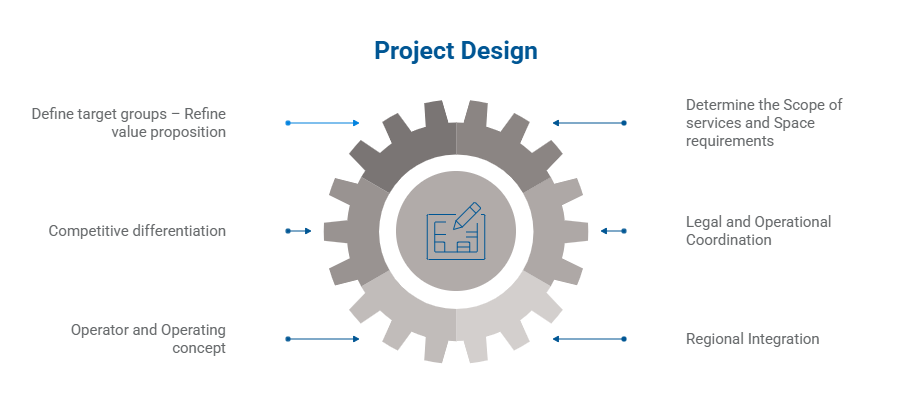
Important elements of project design
- Define target groups and sharpen value propositionsDerive a tailor-made range of services and space allocation plan
- Derive a tailor-made range of services and space allocation plan
- Work out competitive differentiation and USP
- Coordinate with legal and operational conditions
- Develop operator and operational concept
- Consider regional integration and value creation
From concept to planning
Based on the concept fundamentals, the space and function allocation plan, technical and design requirements, time and budget planning follow. The operational logic, such as routing, capacities, personnel deployment and service processes, is crucial. All of this must be taken into account in the planning and design so that the project runs efficiently in day-to-day business.
Profitability and feasibility calculation
Before decisions are made, the revenue and cost basis is quantified. Revenue generation includes price and occupancy assumptions as well as additional revenue from catering, leisure, spa or events. This is offset by investment costs (capex) and ongoing expenses (opex), including staffing, energy, maintenance and sales. Scenario and sensitivity analyses test the robustness of the project in the event of changes in demand, price levels or costs. Only when this analysis confirms a coherent opportunity/risk profile is it advisable to approve the project.
A well-conceived and thoroughly calculated project reduces risks, accelerates decisions and creates the basis for a successful market entry – with a facility that functions operationally, is financially viable and convinces guests in the long term.
Location analyses & market analyses
A sound basis for viable decisions
The success of a hotel or tourism project depends crucially on location and market factors. An independent analysis provides the basis for realistically assessing opportunities, minimizing risks and optimizing the project’s alignment with demand.
The location analysis evaluates the geographical location, accessibility, infrastructure, tourist appeal and environment of the project. Seasonal influences, the local competitive situation and possible synergies with existing offerings are also taken into account. For operators and investors, it is crucial to know whether the location will attract the target groups in the long term and whether the general conditions are sustainable. The market analysis examines existing supply and demand in the relevant target markets. This includes arrivals, overnight stays, occupancy rates, length of stay, price levels, guest structure and trends in travel behaviour. The analysis takes into account local, regional and supra-regional developments.
Key questions in location and market analyses
- What is the potential demand in the catchment area?
- How strong is the competition and how are competitors positioned?
- What seasonal patterns characterize occupancy and pricing?
- What infrastructure and framework conditions are critical to success?
- What market trends could influence supply and demand?
The analysis combines quantitative data (e.g. official tourism statistics, occupancy figures, price levels) with qualitative assessments (e.g. brand perception, service quality in the market, diversity of offerings).
A well-founded location and market analysis ensures that investments in a project are based on solid foundations and shows how the location and market environment affect demand, occupancy and economic prospects.
Feasibility Studies
Sicherheit Certainty before the investment decision
A feasibility study is the key tool for assessing the chances of success and risks of a planned hotel or tourism project before an investment decision is made. It combines market and location analysis with a detailed profitability calculation, thus providing an objective basis for decision-making for investors, operators, banks and public funding agencies.
The process begins with a comprehensive location analysis that examines factors such as location quality, accessibility, infrastructure connections, tourist appeal and seasonal influences. This is followed by an assessment of demand potential, occupancy patterns, price levels, target group profiles and competitive strategies in the market analysis.
On this basis, the project concept is specified in terms of capacities, service structure, service elements, operating model and unique selling points (USPs). The subsequent profitability calculation is the core of the study. It includes revenue derivation broken down by business areas such as accommodation, gastronomy, events, spa or additional services. Assumptions regarding prices, occupancy, average expenditure per guest and additional revenue are backed up by reliable market data. On the cost side, investment costs (capex) and ongoing operating costs (opex) are calculated, including personnel, cost of goods, energy, maintenance, marketing and sales.
Scenario and sensitivity analyses examine how changes in demand, price levels or cost structures affect profitability, break-even points and amortization periods. This reveals how robust the project is under different conditions.
Typical applications for feasibility studies
- Development of new hotel, resort or leisure projects
- Examination of major renovations or expansions
- Evaluation of alternative utilization concepts
- Decision-making basis for banks, investors and funding agencies
- Support in the selection of locations or operators
„Numbers have an important story to tell. They rely on you to give them a voice.“ – Stephen Few
A feasibility study is not a formal requirement, but a strategic tool for securing investment decisions, minimizing risks and realistically assessing opportunities. It ensures that a project is not only visionary, but also economically viable and successful in the long term.
Assessment of existing studies (second opinion)
Unabhängige Prüfung für klare Entscheidungen
Investitionsentscheidungen im Tourismus werden häufig auf Basis von bereits erstellten Machbarkeitsstudien, Marktanalysen oder Businessplänen getroffen. Eine Second Opinion bietet die Möglichkeit, diese Unterlagen nochmals kritisch zu prüfen, Lücken aufzudecken und die Annahmen mit aktuellen Daten und Markttrends abzugleichen.
The advantage of an independent review lies in its neutrality. As an external project consultant, I evaluate figures, assumptions and forecasts exclusively in terms of their plausibility and feasibility and derive my recommendations from this.
The second opinion begins with a structured review and analysis of the available documents. Assumptions about market and location potential are compared with current data from location analyses and market analyses. The profitability calculations are subjected to a plausibility check and, if necessary, supplemented with alternative scenarios. Another focus is the evaluation of the overall project. Are the offer, capacities, target groups and price level compatible with each other? Are investment costs and operating expenses realistically estimated? Are possible risks, such as seasonal fluctuations or market changes, sufficiently taken into account?
Typical questions for a second opinion
- Are the data sources accurate and up to date?
- Are the market and demand forecasts comprehensible?
- Have competitive factors been assessed realistically?
- Is the cost structure complete and in line with the market?
- Are there any opportunities or risks that have not been considered?
„Trust, but verify.“ – Ronald Reagan
The second opinion concludes with a clear, objective evaluation report containing recommendations for action. This may either confirm the original study or provide well-founded approaches for corrections and optimization. An independent second opinion protects against misjudgments, increases investment security and gives decision-makers the certainty that their plans are based on a sound foundation.
Pre-opening planning, budgeting, steering & controlling
The optimal start for lasting success
The pre-opening phase is one of the most crucial stages in the realization of a hotel or tourism project. This is the time when it is determined how smoothly operations will start, how quickly guest satisfaction and occupancy rates will be achieved, and whether the economic goals will be met.
The pre-opening plan – the heart of the preparation
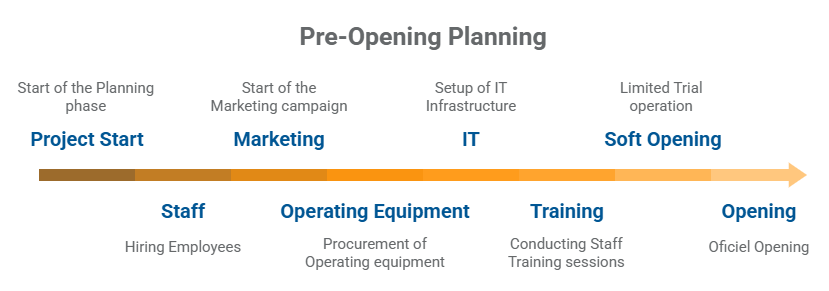
The central tool is a detailed pre-opening plan that covers all tasks from the start of preparation to the opening day. This plan is divided into areas such as HR, marketing & sales, operating equipment (OSE), IT, legal aspects & approvals, purchasing, training and test operation, and lists the following for each item:
- Responsible employees or teams
- Deadlines (months, weeks, days before opening)
- Interdependencies between tasks
This creates a clear timeline that avoids bottlenecks, defines responsibilities and makes project progress transparent.
The pre-opening budget covers all operating costs up to the opening, including in particular:
- Staff cost for recruitment and training
- Marketing and sales cost for market launch
- Opening events and PR activities
- Operating Service Equipment (OSE)
- IT and communication systems not supplied by the constructor
- Reserves for unforeseen expenses
As a rule, the budget for the first operating year or short financial year is also prepared during the pre-opening phase.
Close monitoring during the pre-opening phase ensures that all tasks are completed on time and budgets are adhered to. This allows deviations to be identified and corrected in good time.
- Success factors in the pre-opening
- Klare thematische Struktur im Aufgabenplan
- Transparent responsibilities and fixed deadlines
- Early coordination between all stakeholders
- Detailed budget for pre-opening and first year of operation
- Ongoing monitoring and rapid response to any deviations
If you don’t know where you are going, you’ll end up someplace else.” – Yogi Berra
Structured pre-opening planning with clear responsibilities, a realistic timeline and a complete budget ensures that operations not only start on schedule but also run efficiently and are financially successful from day one.
Preparation of business plans
Strategic roadmap for economically viable tourism projects
A business plan in the hotel and tourism sector is much more than just a document for banks or investors. It is the strategic guideline for the entire project development and subsequent operation. It combines concept, market analysis, organizational structure and financial planning in a structured framework and enables well-founded decisions based on facts and figures.
Contents of a business plan
A professional business plan includes:
- Detailed project description with unique selling points and strategic positioning
- Market and location analysis with realistic forecasts
- Appropriate service and space program
- Marketing and sales strategy
- Organizational and personnel planning
- Forecast with planned profit and loss statement, return on investment
The central element is the budget. It includes detailed revenue and cost forecasts for the first years of operation, a break-even analysis, the calculation of the payback period and sensitivity analyses. This shows how changes in demand, prices or costs affect profitability.
A professionally prepared business plan not only improves financing opportunities but also reduces investment risks and provides all parties involved with a clear, verifiable roadmap for the operational launch and long-term profitability.
Preparation of space and function programs
Efficient space planning for optimal operational processes
The space and function program is the connecting interface between concept, construction planning and operational management. It defines exactly which areas and functions are required for a successful hotel or tourism business and how these must be arranged to ensure efficient processes. It includes:
- Determination of the space required for each business area (accommodation, gastronomy, conferences, wellness, leisure, service areas)
- Definition of functional relationships to ensure efficient routing and logical workflows
- Consideration of operational logistics, service quality and guest experience
- Adaptation to legal regulations and technical standards
A well-thought-out space and function plan prevents inefficient routing, avoids expensive renovations and ensures that space is used optimally – both from an economic perspective and in terms of comfort and service quality.
Project monitoring & project controlling for new constructions or renovations
Deadlines, budgets and quality under control
Deadlines, budgets and quality under control
Investment projects in tourism are complex and require close coordination of construction progress, budget control and operational preparation. Project monitoring and project controlling ensure that deadlines, costs and quality standards are met.
Project monitoring roughly comprises the following services
- Regular progress reports to investors and owners
- Monitoring of budget compliance and ongoing cost control
- Quality assurance in all relevant areas
- Early identification of risks and bottlenecks
- Close coordination with construction management, specialist planners and operator teams
Professional project controlling reduces the risk of budget overruns, schedule delays and quality defects, and creates full transparency for investors and operators.
Accompanying control and owner representation in projects
Security for investors
For investors and owners who cannot be on site themselves or do not have internal resources for project support, professional owner representation is crucial. It ensures that projects are realized within the planned economic and qualitative framework.
The controlling tasks include
- Representing the owners’ interests vis-à-vis all project participants
- Monitoring quality, budget and deadlines
- Ensuring compliance with contractual and performance requirements
- Proactive communication with investors, banks and funding agencies
- Support with strategic decisions in the implementation phase
Particularly in projects with lease or management agreements, continuous owner representation is an effective tool for ensuring the sustainable profitability and long-term value retention of the property.