
Operation, Controlling & Asset Management
Conception, planning, and calculation of hotel and tourism projects, accompaniment and support in all project phases from the idea to the realization
Long-term success in the hotel, catering and tourism industries requires more than just a good product. Clear operational structures, transparent key figures and consistent control of all relevant processes are crucial. Operation, controlling and asset management form the strategic basis for this.
The aim is to systematically improve the performance of the business by optimising processes, introducing efficient reporting and monitoring systems, and forward-looking planning. This also includes profitability calculations and feasibility studies, which provide clarity about market opportunities, profitability and risks before investments are made.
My service portfolio ranges from detailed operational analyses and quality management to targeted personnel planning, budgeting and profitability audits. For owners, operators and investors, this means maximum transparency, sound decision-making bases and the certainty that the property and its operation are being optimally managed, maintained and developed.
Business l analysis (key figure analysis, benchmarking)
Understanding figures and exploiting potential
A precise business analysis reveals the economic position of a tourism business and shows where revenues can be increased, costs reduced and processes optimised. It is based on existing figures such as management reports, balance sheets, profit and loss statements, balance sheets and other department-specific figures. The aim is to derive the key performance indicators from this data and place them in a meaningful context.
Revenue analysis – identifying revenue potential
Revenue analysis takes a detailed look at which business areas contribute what share to total revenue. In the hotel industry, these are typically accommodation, gastronomy, events and additional services. Important key figures are determined from the revenues, including occupancy (ratio of units sold to units available), average daily rate (ADR), revenue per available room (RevPAR), total revenue per available room (TRevPAR) and average revenue per guest. These values are differentiated according to season, market, target group and sales channel in order to identify seasonal patterns, demand potential and revenue opportunities.
Cost analysis – exploiting efficiency potential
Cost analysis evaluates the expenditure side of the business. In addition to a breakdown by cost type, such as cost of goods, personnel, energy, marketing, maintenance and administration, key figures such as the personnel cost ratio, the cost of goods ratio, the cost per occupied unit and profit-oriented variables such as gross operating profit (GOP) and EBITDA are also analysed. The aim of this analysis is to identify areas with disproportionate costs in relation to performance and to derive concrete measures for increasing efficiency.
Key figures on liquidity and debt
In addition to earnings and cost figures, the financial flexibility of the business is crucial. Here, values such as cash flow, the liquidity ratio (ratio of liquid assets to current liabilities) and the debt ratio (ratio of debt to equity) provide information about how well the business can cover its current obligations, finance investments from its own resources and react to short-term market changes. These key figures represent a selection of common metrics. Depending on the type of business, market environment and objectives, additional values can be included in the analysis to obtain a complete picture of the economic situation.
“You can’t manage what you can’t measure,” – Peter Drucker
Only by comparing with your own previous year’s figures (internal) or with comparable businesses (external) the significance of the key figures can be fully realised. Benchmarking helps to realistically assess the market position, systematically build on strengths and address weaknesses.
Practical benefits of a business analysis
- Clear overview of the income and cost structure
- Identification of untapped potential
- Basis for budget and investment decisions
- Early warning system for liquidity bottlenecks
- Basis for strategic objectives
A professionally conducted operational analysis not only provides a snapshot, but also reveals correlations and causes. It enables targeted adjustments to be made in order to increase profitability, optimise cost structures and secure the desired economic results in the long term.
Quality management and guest surveys
Ensuring quality – systematically enhancing guest satisfaction
Effective quality management ensures that service quality is not left to chance. In hotels, restaurants and tourist businesses, this means securing all processes – from the first guest contact to departure – through clear standards and procedures (standard operating procedures – SOPs), anchoring them in the team and reviewing them regularly.
Implementing quality management in your business
The cornerstone is written standards for core processes such as check-in, service, catering, complaint management and other operational procedures. These standards define how services are provided, what quality criteria apply, who is responsible and how they are monitored. Training courses and practical training ensure that the entire team not only knows the processes, but also understands why they are crucial for guest satisfaction and economic success.
Guest surveys and online reviews as a driver of quality
Modern quality management is based not only on internal guidelines, but also on external feedback. Today, guests provide most of their feedback online, whether via review platforms such as Google, Booking or Tripadvisor, or via digital guest surveys after their stay.
The crucial step is the structured evaluation of this data. With suitable analysis tools, results from different sources can be bundled and condensed into an overall score. Systems such as TrustYou or ReviewPro summarise hundreds of individual reviews into an easily interpretable key figure, identify recurring themes and filter out strengths and weaknesses. This saves time, increases the informative value and provides a clear list of priorities for improvement measures.
Best practices in quality management
- Document standards and processes in writing and update them regularly
- Systematically collect, bundle and evaluate guest feedback from multiple sources
- Evaluate results and consolidate them into an overall score
- Plan improvement measures
- Train staff and implement the measures
- Monitor the impact and adjust standards as necessary
„Customers don’t expect you to be perfect. They expect you to fix things when they go wrong.“ – Don Porter
By consistently combining internal quality management and external guest reviews, you create a closed improvement process. This not only ensures higher guest satisfaction and a better online reputation, but also has a direct positive effect on key figures such as occupancy, average rate and rebooking rate.

Customer Experience Management & Customer Journey
Exceeding guest expectations – creating positive emotions and strengthening loyalty
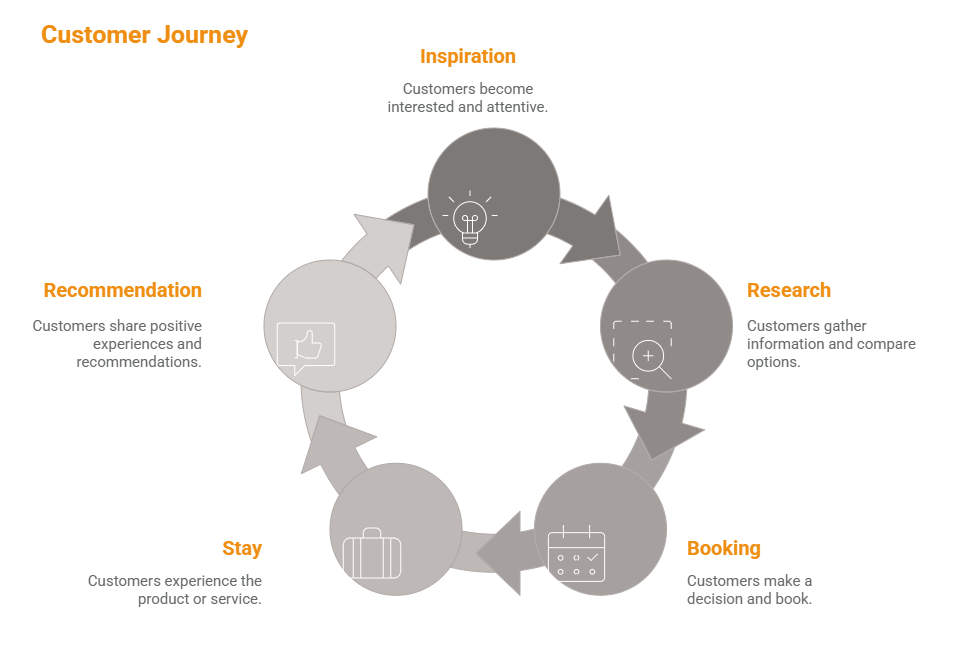
An outstanding customer experience is created when expectations are not only met, but exceeded. Positive emotions at every touchpoint have a long-term effect on loyalty, recommendations and willingness to rebook. In tourism, customer experience management (CEM) means consciously shaping the entire guest experience – from the first moment of inspiration to post-stay support.
Inspiration
The travel decision-making process often begins with an impulse, such as an atmospheric photo, a personal recommendation or an inspiring story on social media. Emotion and authenticity are what count in this phase. Professional images, storytelling and clear messages convey not only what is on offer, but also the lifestyle that guests can expect on site. The aim is to arouse curiosity and create an emotional desire to find out more.
Information & Planning
Once interest has been aroused, guests search specifically for reliable information such as location, facilities, availability, prices, reviews, activities and events in the surrounding area. The website is the most important point of reference here and must be mobile-optimised, up-to-date and search engine friendly. Clear navigation, comprehensive content, inspiring imagery and transparent pricing are crucial. A presence on relevant online channels and destination platforms is also important in order to be visible in all search phases.
Booking
Trust, simplicity and flexibility are key in the booking phase. A smooth booking process with clear prices, real-time availability and secure payment methods reduces cancellation rates. Guest reviews, certificates and sustainability seals help to build trust. Communicating the advantages of direct bookings – such as better prices, upgrades or additional services – helps to reduce dependence on OTA commissions.
Stay
The stay begins already before arrival. Targeted pre-arrival communication a few days beforehand – by email or app – increases anticipation and orientation. Guests receive information about arrival, check-in, parking, booked services and tips on activities. Upon arrival, guests should receive all relevant information immediately in a compact form, either in person, digitally or a combination of both. This includes service hours, dining options, wellness and leisure activities, events and recommendations for the current length of stay. This allows the guest experience to begin immediately. During the stay, the aim is to meet or exceed expectations. Important success factors include a quick, friendly check-in, well-maintained facilities, smooth service processes, flexible responses to special requests and little extras that provide a pleasant surprise.
Follow-up & loyalty
Contact with guests does not end after their stay. Prompt, personalised follow-up communication strengthens the relationship and encourages repeat visits, such as:
- Thank you message by email
- Automated or personalised guest survey
- Targeted offers based on previous stays
- Maintaining the relationship via social media, newsletters or loyalty programmes
Technology as support
Digital systems such as CRM (customer relationship management) software bundle guest data from all channels and enable personalised communication. Modern tools analyse interactions in real time, recognise patterns and derive optimisation potential from them. This allows processes to be designed more efficiently, service offerings to be individually tailored and experiences to be specifically improved – based on reliable data rather than assumptions.
Success factors for a strong guest experience
- Clear visualisation of all phases of the customer journey
- Consistent messaging across all channels
- Combination of digital convenience and personalised service
- Systematic collection and evaluation of guest data
- Quick response to feedback and trends
„Creating exceptional customer experiences isn’t a competitive advantage anymore; it’s a fundamental necessity.“ – Sarah Lee
Through a consciously designed guest experience, supported by clear processes, targeted communication and technological monitoring, a business can not only increase customer satisfaction, but also measurably improve profitability and efficiency. This leads to sustainable economic success and reflects precisely those values that are crucial in professional tourism management.
Standards & Procedures – Making quality measurable and assured
Guidelines for consistently high service quality
Standards and procedures (Standard Operating Procedures – SOPs) are the foundation for a consistent level of quality in operations. They define binding rules for how key processes are carried out, which quality criteria apply and who is responsible for compliance. Especially in hotels, restaurants and tourist facilities, they create reliability for guests and ensure consistent service quality.
From definition to lived practice
An effective SOP system begins with the systematic recording of all core processes. Depending on the business, these range from arrival organisation to the check-in process, housekeeping standards, catering services, event management and complaint handling. The following points are defined for each process:
- Step-by-step description of the process
- Responsibilities and substitution arrangements
- Quality standards and measurement criteria
- Required resources, materials and checklists
Ideally, these are developed together with the employees who implement the processes on a daily basis. This ensures that the standards are practical and realistic and that the team actively supports the guidelines.
Standards are a central instrument of quality management and have a direct impact on the customer journey. They ensure that the desired guest experience is reliably implemented at all touchpoints – from booking to on-site service to aftercare. Every defined process should be geared towards exceeding guest expectations and ensuring consistent service quality.
Training as a key factor
Even the best standards remain ineffective if they are not trained. That is why training is an integral part of successful SOP implementation. This combines theory, practical exercises and feedback loops. New employees receive structured introductory training, while existing teams benefit from regular refresher training. Training concepts should also take soft skills into account, such as dealing with complaints or intercultural communication.
Monitoring and further development
Standards are dynamic instruments that must adapt to changing guest expectations, market conditions and operational circumstances. Regular reviews – for example, through internal audits, mystery checks or feedback analyses – show whether the guidelines are being adhered to. Findings from guest reviews, social media monitoring or employee surveys help to optimise processes.
Best practices for standards & procedures
- Clearly document processes with concise texts and supporting visualisations
- Assign responsibilities clearly
- Plan and document mandatory training
- Regular monitoring through audits or mystery guests
- Actively incorporate feedback from guest reviews and team meetings
A clearly documented SOP system that is actively implemented in the business not only ensures consistent quality, but also increases efficiency, reduces error rates and increases guest satisfaction. It facilitates the training of new employees, ensures consistent processes and creates the basis for targeted quality management. Businesses that regularly review and actively develop their standards are better able to adapt to changing market conditions and guest expectations, and thus remain successful in the long term.

Management Information System (MIS)
Using data as a basis for decision-making – transparency and control for the hotel and tourism industry
A Management Information System (MIS) is a central tool for recording, analysing and presenting the most important operational key figures in a structured and comprehensible manner. It provides the basis for informed decisions – from day-to-day operations to strategic planning. For hotels and tourism service providers, this means having a clear overview of occupancy, revenue, costs and guest feedback at all times.
Function and benefits of an MIS
A well-designed MIS collects data from various sources such as reservation systems, controlling, guest review portals or personnel management – and processes it in such a way that it is easy for management to read. In addition to traditional financial indicators, operational performance indicators such as occupancy, ADR, RevPAR, F&B revenue per guest, personnel cost ratio and guest satisfaction ratings are also integrated. For everyday tourism operations, it is crucial that an MIS not only provides figures, but also gives concrete ideas for action. For example, a sudden drop in occupancy in a particular season can be identified at an early stage so that targeted marketing measures can be taken to counteract it. Pricing strategies can also be continuously optimised based on current booking trends.
Modern MIS solutions offer interfaces to common hotel software systems (PMS, POS, accounting, CRM), enabling largely automatic data collection. Dashboards visualise the results in real time and make developments visible at a glance. Cloud-based systems also offer the advantage that key figures can be viewed from any location.
Advantages of a functioning MIS in tourism
- Overview of all relevant key figures in real time
- Early detection of trends and deviations
- Basis for data-driven decisions
- Increased efficiency through automation
- Transparent communication within the management team
„Without data, you’re just another person with an opinion“ – W. Edwards Deming
A well-structured management information system creates transparency, promotes proactive corporate management and enables opportunities and risks to be identified at an early stage. Companies that consistently base their decisions on current data can react faster, invest more selectively and operate more profitably in the long term.
Individual and efficient tools in MS Excel
Tailor-made solutions for your business for practical evaluations and planning
Not every business needs complex, expensive software solutions. Often, a well-designed, custom-developed Excel tool is all that is needed to perform key evaluations, planning and forecasting with precision. The decisive advantage lies in customisation: as a consultant, I tailor each tool specifically to the specific structures, key figures and goals of the respective company – and it is ready for immediate use.
Functions and areas of application – Customised Excel tools can cover a wide range of tasks
- Revenue and cost analyses with automatic key figure calculations
- Budget planning and forecasts
- Actual/target comparisons for individual departments or the entire company
- Occupancy and price development over time
- Staff deployment planning based on utilisation forecasts – Investment calculations and profitability analyses
A tailor-made Excel tool offers full transparency regarding the calculation logic and avoids dependencies on expensive, rigid software solutions. It can be adapted to changing conditions or new strategies at any time and is immediately available without long implementation times.
„The simpler you can make things, the better it works.“ – Gordon Bell
Tailor-made Excel tools offer the perfect balance between functionality, flexibility and cost control. They enable you to collect and evaluate exactly the information that is relevant to your business, so you can make decisions faster, design processes more efficiently and pursue economic goals in a targeted manner.
Employer branding – positioning as an attractive employer in tourism
Employee recruitment and retention as a strategic success factor
In tourism, it is not only the product that determines success, but also the team that brings this product to life. Employer branding – the targeted positioning as an attractive employer – helps to attract and retain qualified specialists and bind them to the company in the long term, which is particularly important given the increasing shortage of skilled workers in tourism.
A strong employer image has an internal and external impact. Internally, it increases motivation, identification and loyalty, while externally it increases the attractiveness for applicants. Employees who are proud of their company become credible brand ambassadors – both to guests and to potential new colleagues.
Best practices for a successful employer brand
Die Entwicklung einer Arbeitgebermarke beginnt mit einer klaren Analyse der eigenen Stärken als Arbeitgeber. Dazu gehören Arbeitsbedingungen, Entwicklungsmöglichkeiten, Unternehmenskultur und besondere Benefits. Darauf aufbauend wird ein klares Leistungsversprechen („Employer Value Proposition“) formuliert, das authentisch ist und die Realität im Betrieb widerspiegelt und effizient kommunizier wird.
- Visibility on relevant job portals and career networks
- Targeted communication on social media with insights into everyday working life
- Training and further education opportunities
- Flexible working time models, where the company allows
- Measures to promote team spirit and employee satisfaction
More information on this can also be found in my blog article „Employer-Branding“
Employer branding should not be viewed in isolation but is part of the overall corporate strategy. It is closely related to staff planning, service quality and long-term competitiveness. Credible employer branding thrives on consistency, which means that the image communicated to the outside world must correspond to the reality experienced.
Success factors in employer branding
- Involving existing employees in the development of the employer brand
- Clear communication of the advantages and special features of the company
- Continuous maintenance and adaptation to new expectations in the world of work
„Take care of your employees and they will take care of your business.“ – Richard Branson
Professionally structured employer branding not only improves the chances of attracting qualified specialists but also increases long-term employee retention. The result is more stable teams, lower staff turnover and improved service quality – a competitive advantage that has a direct impact on guest satisfaction and economic success.
Staff planning & training
Optimising and developing teams – strategic human resources management for sustainable business success
In the tourism industry, human resources management is one of the key factors for quality and profitability. Forward-looking staff planning ensures that sufficient qualified employees are always available. In conjunction with targeted training programs, this improves service quality, optimises processes and increases employee retention.
HR planning goes far beyond creating duty rosters. It begins with a needs analysis that takes into account seasonal fluctuations, capacity forecasts and strategic corporate goals. Key steps include defining the required job profiles, analysing the current team structure, comparing target and actual staffing levels, and integrating the results into long-term strategies such as employer branding or corporate planning. As an external consultant, I support companies in creating efficient personnel planning that covers both current and future requirements.
Continuing education is not a one-time event, but an ongoing part of successful business management. Training concepts include both technical content (e.g. work processes, product knowledge, system use) and soft skills such as complaint management or intercultural communication. An effective program follows a clear sequence: identification of requirements → training concept → implementation → performance review → ongoing adjustment. In practice, a combination of induction plans for new employees, on-the-job training, compact workshops and e-learning courses has proven successful.
Best practices for personnel planning & training
- Planning personnel requirements based on realistic capacity utilisation forecasts
- Standardising and documenting induction plans
- Conducting training regularly and in line with requirements
- Measuring training results and adjusting them if necessary
- Considering interfaces with quality management and service processes
„An investment in knowledge pays the best interest.“ – Benjamin Franklin
Well-thought-out personnel planning combined with continuous training ensures motivated, efficient teams, stable processes and high service quality. Investing in qualifications and skills development has a direct impact on guest satisfaction, economic results and long-term competitiveness.
Cost audit and optimization options
Increase profitability in a targeted manner – transparency in expenditure and targeted cost reduction without compromising quality
A systematic cost audit shows where a business is economically well positioned and where there is potential for savings. This is not about across-the-board cuts, but rather intelligent optimisations that increase efficiency, improve profits and maintain or even increase guest satisfaction.
The first step is a detailed review of all types of costs – from the cost of sales and personnel costs to energy consumption and marketing and sales expenses. The aim is to obtain a complete picture of how the costs are composed and which items have the greatest impact on the operating result. In addition, a comparison is made with typical industry figures to see how these costs are developing.
Typical starting points in tourism for identifying optimisation potential include more efficient staff scheduling, better purchasing conditions, reduction of energy and water consumption, optimisation of the cost of goods in the kitchen and service, and more focused marketing budgets. The use of modern technologies, such as in energy management or the automation of recurring processes, can also reduce costs in the long term.
Experience shows that even well-managed businesses often ignore hidden cost drivers. External consulting can help identify and easily remedy these. This may mean renegotiating supply contracts, optimising menus to better balance the use of goods and guest preferences or streamlining processes to deploy staff in a more targeted manner.
As a consultant, I support businesses not only in the analysis, but also in the practical implementation of the optimisations. The aim is to anchor improvements in a sustainable manner so that savings are not only short-term, but long-term.
Best practices in cost management
- Review the entire cost structure at least once a year
- Analyse and prioritise large cost blocks in a targeted manner
- Use key figure comparisons with industry averages for guidance
- Develop an action plan
- Implement cost savings
- Document successes and monitor effects
„Beware of little expenses; a small leak will sink a great ship.“ – Benjamin Franklin
A targeted cost review followed by optimisation not only leads to better profitability, but also strengthens competitiveness. Those who know their costs can manage more consciously, react more quickly and create scope for investment in quality and innovation.
Budgeting incl. target/actual comparison and forecasts
Precise planning for maximum control – set realistic financial goals and adjust them flexibly
Sound budgeting is the backbone of any successful business management in tourism. It determines what revenues and costs are expected in a given period, thus providing a reliable basis for investments, staff planning and marketing activities.
The revenue budget covers all planned income, broken down by business areas, sales channels or target groups. Detailed planning, e.g. with turnover per day instead of per month, increases accuracy and makes short-term variances visible more quickly. The cost budget shows all expected expenses, broken down by cost types such as staff, cost of sales, energy, maintenance, marketing or administration. Here, too, the law of small numbers applies: the more detailed the planning units, the lower the risk of large deviations from the plan in the total amount.
The target-actual comparison shows whether the business is operating within the planned framework. It compares the actual results with the budget values and makes deviations transparent. It is crucial to carry out this comparison not only annually or quarterly, but at least monthly, and in dynamic markets even weekly.
Forecasts are continuously updated projections based on current booking status, sales trends and cost developments. They complement the original budget and help to adjust marketing or sales measures and cost control in a timely manner. Forecasts are a key control tool, especially in tourism, where demand and capacity utilisation often fluctuate greatly.
Best practices for budgeting and forecasts
- Plan revenue and cost budgets separately and in detail
- Use small time units (days, weeks) instead of just monthly or annual values
- Combine historical data with current market information
- Carry out target-actual comparisons at least monthly
- Continuously update forecasts and derive measures
„He who fails to plan is planning to fail” – Winston Churchill
A clear separation of revenue and cost budgets, combined with monthly target-actual comparisons and ongoing forecasts, creates maximum transparency. Those who plan in detail and make regular adjustments minimise risks, recognise opportunities more quickly and can use resources efficiently.
Representation of the interests of owners and investors
Holistic asset management for sustainable value preservation
For tourism properties such as hotels, resorts or serviced apartments, combining economic performance with long-term value preservation is crucial. As a consultant, I act as an intermediary between the owner and the operational management to ensure that the property is managed efficiently, remains in good condition and generates the planned return.
The focus is on securing and increasing the value of the property in the long term. This includes assessing profitability, deriving strategic goals and planning modernisation and investment measures, taking market developments into account. In addition to the strategic level, the task includes controlling, monitoring and evaluating operational key figures such as turnover, GOP, occupancy or RevPAR. Regular analyses ensure that budgets are adhered to, standards are implemented and processes are designed efficiently. This also includes consulting in areas such as personnel strategy, marketing and the implementation of cost optimisation and budget planning measures.
Professional asset management ensures that the property maintains its value through ongoing maintenance and timely renovation measures. Capex investments (capital expenditures) are planned taking into account urgency, economic efficiency and strategic benefits. At the same time, compliance with all relevant legal requirements and safety standards is monitored.
A key component is clear, transparent communication with owners and investors. Regular reports provide up-to-date information on economic developments, market trends and the status of ongoing projects. The reports contain key figures, analyses and specific recommendations for action to enable decisions to be made on a sound basis.
Professional asset-management combines strategic foresight with detailed operational knowledge. This not only optimises ongoing operations but also creates the basis for sustainable economic success and long-term value enhancement.
Evaluation & control of lease and management agreements
Clear framework conditions for sustainable success – understanding agreements, minimising risks, securing returns
Lease and management agreements form the basis of many types of tourism businesses, whether hotels, resorts or leisure facilities. They define the cooperation between owners and operators, regulate financial obligations and allocate responsibilities. Regular evaluation of these contracts is crucial to ensure that they are economically viable, in line with market conditions and sustainable for the future.
The first step is to thoroughly review the contents of the contract. This includes the amount and structure of payments, regulations on investments (capex) and ongoing maintenance, reporting and controlling obligations, terms and conditions, and termination modalities. It is crucial to determine whether the agreements are still in line with the current market environment, the earnings situation and the strategic orientation of the business.
Rental and lease models
The most common models are fixed leases (an annually fixed amount that offers the owner planning security and shifts the risk to the operator) and turnover leases (a percentage of turnover that shares opportunities and risks, with income fluctuating depending on occupancy and price levels, often combined with a minimum lease). There are also hybrid models that combine fixed and variable components to ensure both security and flexibility.
Management contracts
In the management model, the manager operates the business on behalf of and at the expense of, and therefore also at the risk of, the property owner. Management contracts usually include a base fee (fixed percentage of turnover, usually 2–4%) and an incentive fee (variable percentage of net operating profit, usually 5–10%). This structure is designed to create incentives to improve operational performance. It is important to establish clear definitions of the assessment bases in order to avoid misunderstandings.
An essential part of asset management is monitoring the agreed responsibilities – from timely payments to compliance with budgeted figures, from quality standards to the implementation of investment plans. Regular target/actual comparisons and audits help to identify deviations at an early stage and agree on actions to be taken.
A careful evaluation and control of lease and management agreements ensures that the interests of all parties are protected, risks are minimised and returns are secured. It is an essential component of the sustainable economic performance of tourist properties.
Profitability calculations for existing and new projects
A sound basis for investment decisions – assess projects for their potential for success before investing
A professional profitability calculation or feasibility study is indispensable in tourism in order to place investment decisions on a solid foundation. Whether it’s a new development, expansion, renovation or concept change, it provides answers to the key question: is the project economically viable and marketable?
The core of any study is an objective assessment of whether a project can be successfully operated at the planned location under the given market conditions. This takes into account not only financial aspects, but also market potential, the competitive situation, demand forecasts and operational feasibility. A well-founded analysis protects against bad investments and creates security for banks, investors and operators.
Stakeholders and their requirements
The results of a feasibility study are of crucial importance for several stakeholder groups. Investors and owners receive a sound basis for decision-making before committing capital for the long term. Banks and financial institutions use the reliable figures to decide on the granting of financing. Operators and management companies use the findings for strategic orientation and personnel planning. Public authorities and funding agencies use the study to assess the regional added value and the compatibility of the project with existing development goals.
Revenue derivation – the basis of all financial planning
Before the actual financial analysis, future revenues must be derived. Room rates, occupancy forecasts, F&B sales, additional services (spa, events, leisure activities) and possible ancillary revenues (rentals, commissions, partnerships) are calculated realistically. These assumptions are based on historical data, market analyses, benchmarks and empirical values from comparable businesses.
- Typical contents of a feasibility study in tourism
- Project and target definition
- Market and location analysis – demand potential, target groups, seasonal fluctuations
- Competitor analysis – capacities, price structures, service profile
- Concept and service development: positioning, USP, scope of services
- Revenue calculation based on realistic market and operating scenarios
- Financial and profitability analysis
- Sensitivity and risk analysis
- Recommendations for action
With over 35 years of experience in tourism and hotel consulting, my broad practical knowledge goes into every feasibility study. This means that industry-specific experience is used to determine realistic occupancy rates, marketable price levels and the influence of trends such as sustainability, digitization and changing guest needs.
Advantages of a professional feasibility study
- Clear basis for decision-making for investors, banks and operators
- Minimization of investment risks
- Optimal alignment of concept and positioning
- Realistic forecasts on economic efficiency and profitability
„Plans are nothing; planning is everything.“ – Dwight D. Eisenhower
A precise feasibility study combines market and competition analysis with financial calculations and strategic consulting. It ensures that projects not only look good on paper but can also be operated successfully in the long term.
Consulting for the efficient use of AI in hotel and tourism businesses
Implementing innovation safely and effectively and using technology as a competitive advantage
Artificial intelligence (AI) is rapidly changing the tourism industry. It enables automation, data-based decisions and personalised guest service – from initial contact to follow-up care. In order to exploit this potential, businesses need to be aware of the opportunities and risks, select the right tools and provide targeted training for their team.
Information & legal basis
The EU AI Act establishes the first binding framework for the use of AI in Europe. For companies in the tourism industry, this means above all transparency, traceability and data protection. Guests must be informed when AI influences their experience, and all systems must be operated in compliance with the GDPR. In addition, risk classes must be reviewed and, if necessary, additional documentation requirements must be met.
Opportunities & risks at a glance
AI can speed up processes, reduce costs and improve guest experience. Examples include personalized offers, dynamic pricing and automated review management. Risks arise when systems are inadequately configured, data is misinterpreted or legal requirements are disregarded.
Applications specific to the hotel and tourism industry
- Service & guest communication – chatbots, translation tools, GPTs
- Marketing & sales – AI-supported target group analyses, campaign optimization, content generation
- Revenue management – dynamic price control, demand forecasts, channel optimization
- Quality management – Automated monitoring of online reviews, sentiment analysis
- Sustainability – Energy and resource consumption analyses to increase efficiency
Choosing the right AI tools depends on your goals, the size of your business and the resources available. Solutions that are GDPR-compliant, easy to use and modularly expandable are preferred. A combination of specialized industry solutions and general-purpose AI systems is often a good choice.
Building AI expertise in your business
Technology is only as good as the people who use it. That’s why training is a key success factor. Employees should understand how AI works, what tasks it can perform and where human decisions remain indispensable. Training topics could include:
- Fundamentals and functioning of AI
- Data protection and AI Act compliance
- Appropriate tool selection & application scenarios in the own company
- Interpretation of AI-supported analyses and recommendations
- Tool and training documentation
„Artificial intelligence is not a replacement for human intelligence, but a tool to amplify it.“ – Fei-Fei Li
Sound AI consulting ensures that opportunities are exploited, risks are minimized and legal requirements are met. In this way, AI is transformed from a buzzword into a practical tool that measurably optimizes processes, improves service quality, increases competitiveness and supports the long-term economic success of the business.