Strategic Planning
Strategic planning transforms visions into tangible results. Tourism Results accompanies you every step of the way, from analysis to implementation – for sustainable success and noticeably better results.
Strategic planning is the basis for sustainable success in the hotel, gastronomy and tourism industries. It provides orientation, sets clear goals and defines the path to achieving them – from the initial analysis to implementation.
Whether it’s a company analysis, strengths and weaknesses profile, business plan or mission statement – each element contributes to ensuring that a business not only reacts to market changes, but also actively shapes its future. With a clear structure, practical concepts and an eye for the essentials, ideas are turned into actionable measures that have a noticeable effect – on the team, on guests and on results. The aim is to achieve measurably better results and ensure long-term success – that’s exactly what TOURISM RESULTS stands for.
Business analysis in hotel operations
Well-structured assessment as the basis for strategic success
What is the current economic, organisational and digital status of the business, and how does it perform in terms of regional competition? A professional business analysis forms the basis for every sound strategic decision and shows where the company stands in terms of economic results, processes, visibility and market positioning compared to its competitors. In the tourism industry in particular, this makes potentials clearly visible, allows weaknesses to be addressed in a targeted manner and directs investments to where they will be most beneficial. The result is greater transparency, a reliable basis for decision-making and a clear prioritisation of the next steps.
The following areas are typically included in the analysis
– Business management and finance – key figures, cost structure, profitability, contribution margins
– Market data and competitive environment – comparison with the region, competitors, opportunities and risks
– Capacity utilization and revenue structure – seasonality, pricing policy, booking channels, revenue quality
– Guests and customer journey – target groups, expectations, feedback, touchpoints
– Organization and team structure – roles, processes, responsibilities, communication channels
– Online presence and digital channels – website, booking platforms, visibility, reviews
What is important in a business analysis
– The analysis is not a control instrument, but a tool for improvement
– Up-to-date, verifiable data and an objective perspective are crucial
– The results are presented in a comprehensible manner and discussed within the team
– The perspective of guests throughout the entire customer journey
– A good analysis not only highlights problems, but above all suggests possible solutions
For many businesses, it makes sense to start with a compact preliminary analysis. The quick check-up offers the opportunity to assess the status quo during a one-day on-site appointment and to outline initial solutions together. This offer is particularly suitable for organizations that are dealing with strategic issues for the first time or are looking for an external second opinion → Mehr zum Quick-Check-up
The results of a company analysis form the basis for all further development steps – be it repositioning, optimizing offerings, investment planning or a systematic improvement process. The insights gained enable more targeted action, the identification of strategic levers and economically effective management. A professional company analysis provides clarity and orientation and an overall picture based on A professional company analysis provides clarity and orientation and an overall picture based on facts that reflects the reality of the business – as a starting point for effective, sustainable further development and improvement.
Strengths/weaknesses profile with Business Model Canvas and SWOT
Understanding the business model – identifying potential and risks – a guide to targeted measures
A well-founded strengths/weaknesses profile clearly shows where a business excels – and where there is room for improvement. The Business Model Canvas provides a clear overview of the business model, while the SWOT analysis complements this basis by evaluating internal strengths and weaknesses as well as external opportunities and risks. For hotels, restaurants and tourism providers, this results in targeted areas of action to expand competitive advantages and exploit growth opportunities.
The Business Model Canvas is divided into nine building blocks that highlight and link key areas of the business model. Starting with customer segments, value propositions, revenue and costs, an overall picture emerges that forms the basis for the SWOT analysis to assess specific internal potential and external challenges.
The analysis with the Business Model Canvas covers the following areas
– Business concept & market position – customer segments, value proposition, channels, customer relationships, revenue streams
– Infrastructure and performance – key resources, key activities, key partners, cost structure
These canvas findings flow directly into the SWOT analysis to produce a clear, strategic assessment.
Canvas und SWOT in Kombination – sinnvoll einsetzen
– Business Model Canvas macht das Geschäftsmodell sichtbar, kompakt und strukturiert
– SWOT‑Analyse liefert eine reflektierte Bewertung von stärken und schwächen sowie externe chancen und risiken
– Die Kombination unterstützt strategische Priorisierung und Ableitung konkreter Maßnahmen
This combination answers typical questions such as:
– How is my business model currently structured?
– Where does it show potential and where are the risks?
– What strategic levers can be derived from this?
For companies that want a quick assessment, the Quick Check Up is ideal. In a one-day on-site appointment, important canvas elements and initial SWOT assessments can be carried out – a practical introduction to strategic reflection.
The insights gained from Canvas and SWOT can be used to derive targeted measures. Whether it’s service offer optimization, structural improvements, new sales channels or market positioning – the analysis guides you step by step towards implementation. Business Canvas and SWOT-analyses the business model in depth and strategically, focusing on those areas that create sustainable performance improvements in hotel operations.
Strategic business planning (short, medium and long term)
Securing the ability to act and actively shaping the future
Strategic planning ensures that a business does not merely react, but actively controls its development. Clear, SMART goals are linked to measures staggered over time – from short-term success to medium-term projects to long-term orientation. In the hotel and tourism sector in particular, this approach creates planning security, a clear orientation and greater efficiency in implementation.
The process is based on the results of a company analysis and a strengths/weaknesses profile. A central component is the clear definition of goals according to the SMART principle – specific, measurable, attractive, realistic and time-bound. This approach ensures that goals are clearly understandable and verifiable for all parties involved. Whether it’s a short-term increase in sales, the medium-term introduction of a new offering or long-term positioning, each goal is designed in such a way that progress and success can be measured.
Planning priorities by time horizon
– Short-term measures – product optimisation, pricing strategy, personnel deployment or marketing activities
– Medium-term projects – renovations, development of new sales channels or sustainability concepts
– Long-term orientation – strategic goals such as brand positioning, major investments, structural changes or succession planning
„An hour of planning can save you ten hours of doing“ – Dale Carnegie
Success factors for strategic planning
– Planning is not a one-off activity, but a continuous process
– Regular review and adjustment keep the strategy up to date
– A clear action plan with responsibilities increases the chances of implementation
– Strategy must be integrated into everyday operations in order to be effective
Here, too, the Quick Check-Up offers a useful starting point. Within a day, short-term optimisations can be identified and, at the same time, the basis for medium- and long-term planning can be laid → More about the Quick Check-Up → Mehr zum Quick-Check-up
Strategic planning provides orientation, prevents purely reactive responses to external circumstances and ensures the sustainable development of the business. It is the bridge between vision and implementation and thus a decisive success factor for every company.
Facilitation of strategy workshops
Creating clarity and preparing decisions together
Strategy workshops give the management team the chance to work on important future topics in a structured way and without distractions. The role of the facilitator is to provide the structure and framework, while the content comes from the business itself. The aim is to support participants in identifying solutions to existing issues themselves and then jointly translating these into an actionable plan. This results not only in a theoretical concept, but also in a practical basis for the entire team to make sustainable improvements.
Success factors for productive workshops
Clear objectives set in advance increase the benefits
External facilitation ensures that the entire team participates in the process
Visualised results with facilitation tools facilitate implementation
A detailed to-do list developed jointly creates commitment
Well-facilitated strategy workshops combine the neutral structure of an experienced facilitator with the internal knowledge of the company. The result is clearly defined goals, shared priorities and a practical action plan that can be implemented directly in the company.
Concepts for operational optimisation and implementation with action plans
Increase efficiency, ensure quality, improve profitability
Operational optimisation means streamlining processes, reducing costs and improving service quality. The concepts are based on in-depth analyses and result in a clear action plan with responsibilities and deadlines. In the hotel and tourism sector in particular, this brings noticeable efficiency gains, cost savings and a stronger competitive position.
The development of an optimization concept is based on the findings from the company analysis and the strengths/weaknesses profile. This results in a clear roadmap with short- and medium-term measures that can be prioritized and implemented in a practical manner.
Typical areas for optimisation
– Process flows and organisation – streamlining of workflows, responsibilities, time and resource efficiency
– Cost and revenue management – reduction of unnecessary expenditure, optimisation of pricing and marketing
– Guest orientation and service quality – optimising the guest journey, target group-oriented offers, quality improvement
– Digital processes – optimising online presence and booking channels, review management
Recipe for success for effective operational optimisation
– Measures must be realistic and operationally feasible
– Prioritisation according to impact and feasibility prevents waste of resources
– A detailed action plan creates clarity and commitment
– Regular performance reviews ensure the sustainability of improvements
The Quick Check-Up is an ideal starting point for quickly identifying the most important areas for optimization. In a compact on-site appointment, initial areas for action can be identified and prioritized – an excellent basis for a detailed action plan → More about the Quick Check-Up → Mehr zum Quick-Check-up
Operational optimization is not a one-off project, but an ongoing process. With a clearly structured action plan based on sound analysis and developed jointly, improvements can be implemented in a targeted manner, progress can be measured, and operations can be strengthened in the long term.
Preparation of business plans
From idea to viable strategy
A professionally prepared business plan is more than just a document for banks or investors. It is the roadmap for the development of the company – whether for a new project, the reorientation of the business or as a basis for investment decisions, and at the same time a central control instrument for achieving goals.
The preparation of a business plan begins with a structured assessment of the current situation. Based on the results of the company analysis and the strengths/weaknesses profile, goals are defined, the market and competitive situation are examined, and economic conditions are determined. This results in a practical plan that takes into account both economic viability and operational feasibility.
Components of a practical business plan for hotels and tourism businesses
– Company and project description – clear presentation of the project, unique selling points and target groups
– Market and competition analysis – in-depth evaluation of demand potential, industry trends and competitors
– Strategic orientation – definition of positioning, offerings, marketing and distribution channels
– Financial planning – budget, investment plan, profitability forecast and liquidity planning
– Implementation plan – schedule, responsibilities, milestones, monitoring
Why a business plan is more than just a financial document
– Serves as a guide for the day-to-day management of the business
– Facilitates decisions on investments and strategic directions
– Ensures transparency towards banks, investors and funding agencies
– Helps to align all team members towards a common goal
The services we offer around business plan development are comprehensive – from the initial gathering of information and joint workshops to the final drafting and presentation. You can find more information on this on the page Business Plan – Your Plan for Success. – Ihr Plan zum Erfolg.
A well-thought-out business plan is the foundation for entrepreneurial success in tourism. It serves as a guide for day-to-day management, provides certainty when making decisions and increases the chances of sustainable profitability, regardless of whether it is a new project or a further development of an existing business. In addition, it helps to align the entire team towards a common goal and ensures transparency for all stakeholders.
Developing a mission statement (vision, mission, USPs)
Sharpening identity, providing orientation, strengthening the brand
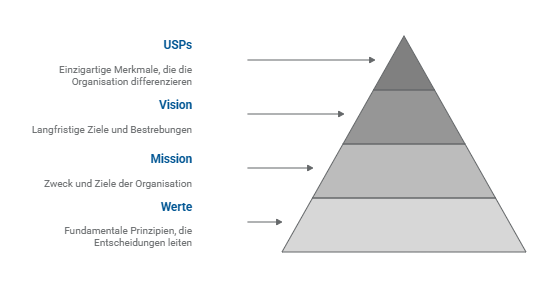
A clearly formulated mission statement is the compass of a hotel or tourism business. It describes what the company stands for, what values it represents and what goals it pursues. Vision, mission and unique selling points (USPs) form the basis for all strategic decisions and marketing measures – and ensure that the business not only reacts to short-term market changes, but also maintains a long-term orientation.
The development of a mission statement is closely linked to strategic corporate planning because it ensures that goals and measures are not only economically feasible but also in line with the corporate identity. In moderated strategy workshops, the vision and mission are jointly developed, refined and reviewed for feasibility – tailor-made for hotels and tourism businesses.
Key components of a mission statement for hotels and tourism businesses
Vision – The long-term vision for the hotel or tourism business describes where the business wants to be in five, ten or more years and what goals guide its business decisions.
Mission – The mission defines the contribution the business makes to guests, employees and the region. It answers the question: ‘Why do we do what we do?’
Values – The principles and beliefs that guide the work of the hotel or tourism business. Values influence service quality, how guests and employees are treated, and attitudes towards sustainability, innovation or tradition.
USP‘s – Unique selling points – Clear strengths that set the business apart from its competitors. For a hotel, these could be an exclusive location, a special culinary focus or a unique service concept. USPs must be clearly identified and consistently communicated in marketing and guest experience.
Why a mission statement is more than just marketing text
– Provides guidance for employees and strengthens internal identification
– Facilitates strategic decisions because it serves as a reference point
– Sharpens the external image and creates recognition in the market
– Helps guests identify with the brand and build trust
If people believe they share values with a company, they will stay loyal to the brand. – Howard Schultz
A clearly defined mission statement links strategic goals with the identity of the hotel or tourist business. A mission statement is a living part of corporate management that is regularly reviewed and adapted to new guest needs, market trends and operational developments. It provides orientation, strengthens the brand and ensures that everyone in the business is working towards the same goal – from management to service staff.
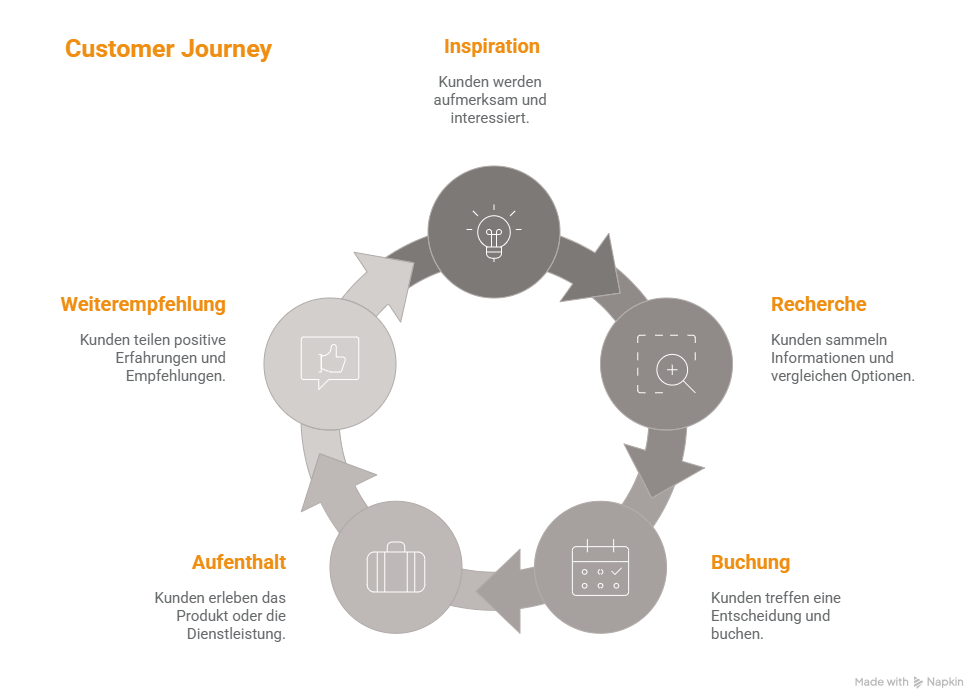
Service offer optimisation from the customer’s perspective
Focusing on the guest experience
Service optimisation focuses on the needs of guests. Throughout the entire customer journey – from inspiration to recommendation – services, packages, prices and communication are tailored to be particularly relevant and attractive to the target groups. Hotels and tourism providers benefit from more bookings, higher satisfaction, stronger customer loyalty and better occupancy rates.
Optimisation is based on the results of the company analysis and the strengths/weaknesses profile. This ensures that changes are not implemented on a gut feeling, but in a well-founded and targeted manner.
Important areas of action in offer optimisation
– Analysis of guest needs – Identifying the expectations, preferences and booking behaviour of target groups, taking into account personal feedback, reviews and guest surveys
– Improvement of the offer structure – Reviewing and adapting existing services, offers and arrangements to increase relevance and attractiveness
– Experience orientation – Designing offers that create emotional experiences and leave a lasting impression along the customer journey
– Price-performance ratio – Adjusting the pricing strategy to optimise competitiveness and perceived value
– Digital visibility of the products & services – Presentation of the offer and bookability on all relevant channels – website, booking platforms, comparison portals and social media – optimised for all end devices
Success factors for offer optimisation
– Consistently focus on guests and take their perspective into account
– Regularly evaluate feedback and incorporate it into the design of the offering
– Coordinate all channels – online and offline – to present a consistent image of the offering
– Make targeted use of seasonal and themed offerings to manage demand
Consistently designing your products and services from the perspective of your guests not only increases satisfaction, but also bookings, revenue and referral rates. Systematic product optimisation is an ongoing process that ensures a hotel or tourism business remains relevant, stands out from its competitors and strengthens its relationship with existing guests, making it a key component of sustainable success in tourism.
Service offer optimisation from the customer’s perspective
Focusing on the guest experience
Service optimisation focuses on the needs of guests. Throughout the entire customer journey – from inspiration to recommendation – services, packages, prices and communication are tailored to be particularly relevant and attractive to the target groups. Hotels and tourism providers benefit from more bookings, higher satisfaction, stronger customer loyalty and better occupancy rates.
Optimisation is based on the results of the company analysis and the strengths/weaknesses profile. This ensures that changes are not implemented on a gut feeling, but in a well-founded and targeted manner.
Important areas of action in offer optimisation
– Analysis of guest needs – Identifying the expectations, preferences and booking behaviour of target groups, taking into account personal feedback, reviews and guest surveys
– Improvement of the offer structure – Reviewing and adapting existing services, offers and arrangements to increase relevance and attractiveness
– Experience orientation – Designing offers that create emotional experiences and leave a lasting impression along the customer journey
– Price-performance ratio – Adjusting the pricing strategy to optimise competitiveness and perceived value
– Digital visibility of the products & services – Presentation of the offer and bookability on all relevant channels – website, booking platforms, comparison portals and social media – optimised for all end devices
Success factors for offer optimisation
– Consistently focus on guests and take their perspective into account
– Regularly evaluate feedback and incorporate it into the design of the offering
– Coordinate all channels – online and offline – to present a consistent image of the offering
– Make targeted use of seasonal and themed offerings to manage demand
Consistently designing your products and services from the perspective of your guests not only increases satisfaction, but also bookings, revenue and referral rates. Systematic product optimisation is an ongoing process that ensures a hotel or tourism business remains relevant, stands out from its competitors and strengthens its relationship with existing guests, making it a key component of sustainable success in tourism.